
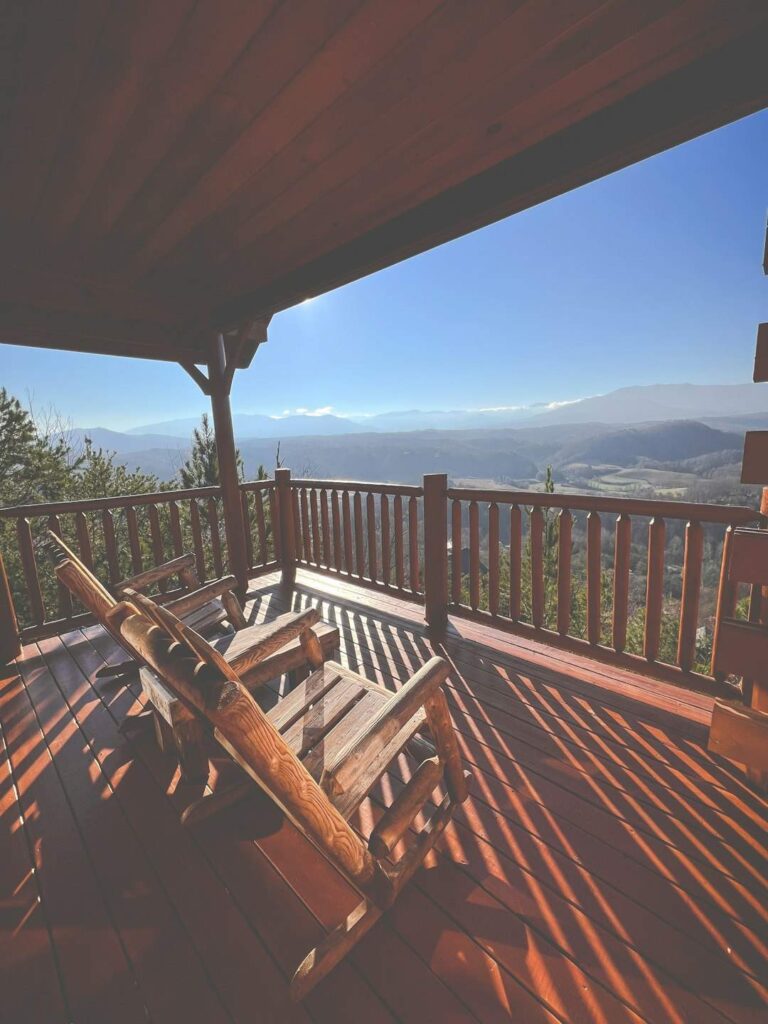
A cabin tucked into a hollow with a mountain view is exactly the kind of place that can have the worst internet in the county. The same rugged terrain that makes the Smokies gorgeous also makes it expensive and difficult for providers to run cable or fiber lines out to every property, so wifi quality swings wildly from one cabin to the next, even within the same subdivision.
If you’re planning to work a few days during your stay, don’t just trust the word “wifi” in the listing. Here’s what to actually check before you book, what kind of internet to expect in different parts of the Smokies, and the mistakes that leave remote workers stuck at a coffee shop in Gatlinburg instead of on their own porch.
Quick Answer
Look for a cabin that lists a specific internet type (cable, fiber, or Starlink) rather than just the word “wifi,” message the rental company to ask about actual speeds and reliability at that specific address, and favor cabins closer to Gatlinburg, Pigeon Forge, or Sevierville proper over deep-mountain or high-elevation cabins, where service is far more likely to depend on satellite or weak fixed wireless.
What to Check Before You Book
Message the property manager directly and ask what type of internet service the cabin has (cable/fiber, DSL, fixed wireless, or satellite like Starlink or HughesNet) and whether they’ve had complaints about outages or slow speeds. Larger cabin companies that manage hundreds of properties, such as Cabins of the Smoky Mountains, Cabins For You, and Timber Tops, generally know this cabin-by-cabin because guests report it.
Ask for the cabin’s exact address or at least its subdivision/road name, then search that road name plus “internet” or check provider coverage maps for Sevier County. Roads close to Gatlinburg, Pigeon Forge, and Sevierville are far more likely to have wired cable or fiber; cabins up steep, winding mountain roads often rely on satellite or fixed wireless instead.
If the listing mentions a dedicated workspace, a desk, or specifically markets itself to remote workers or “digital nomads,” that’s a decent signal the owner has already thought about connectivity, since they’d otherwise get bad reviews from people trying to work.
Read recent reviews specifically for words like “wifi,” “internet,” “signal,” or “work remotely” rather than trusting the star rating alone. A cabin can have a great overall rating while still having internet that drops during storms or heavy rain, which is common with satellite service.
If you have a trip coming up fast and can’t verify in advance, have a backup plan: know where the nearest library, coffee shop, or co-working-friendly spot in Gatlinburg, Pigeon Forge, or Sevierville is, in case the cabin’s connection can’t handle a video call.
Why Mountain Terrain Makes Internet Unpredictable
Running cable or fiber lines up steep, winding mountain roads to spread-out cabins is far more expensive and labor-intensive than wiring a flat subdivision, so providers often don’t bother extending wired service that deep into the hills. That’s the main reason a cabin a mile down the same road from a well-connected one can end up with a completely different setup: it comes down to whether wired lines were ever run past that particular property, not a dropped signal.
In tourist hubs like downtown Gatlinburg and Pigeon Forge, wired cable or fiber is common and generally reliable because the infrastructure is already built out for dense commercial areas. In more rural or higher-elevation parts of Sevier County, properties are more likely to rely on Verizon or AT&T fixed wireless, or satellite internet such as Starlink, HughesNet, or Viasat, where wireline buildout hasn’t reached. Those wireless and satellite technologies, unlike cable or fiber, do depend on a clear signal path, so ridgelines and tree cover can also work against them.
Satellite internet has improved a lot with low-orbit systems like Starlink, which can support video calls reasonably well in good conditions, but it’s still more sensitive to heavy tree cover, dish placement, and severe weather than a wired connection. If a cabin lists Starlink as its internet, that’s not a dealbreaker, but it’s worth asking how exposed the dish’s view of the sky is, since dense forest canopy around a cabin can degrade it.
Cell signal for a personal hotspot as backup is also terrain-dependent. Carrier coverage maps are a rough guide, but actual signal strength in a mountain hollow can be much weaker than the map suggests, so don’t count on your phone’s hotspot as a guaranteed fallback without checking reviews or asking locally.
Tips / Common Mistakes
Don’t assume “free wifi included” means it’s fast enough for video calls. That phrase is standard in nearly every cabin listing regardless of actual speed or reliability, so it tells you almost nothing on its own.
Don’t book the most secluded, deepest-in-the-woods cabin for a work trip just because the photos are stunning. The more remote and elevated the location, the more likely you are to be on satellite or weak fixed wireless.
Do test the connection the moment you arrive, before you’re relying on it for a meeting. Run a quick speed test and try a real video call so you have time to call the rental company or find a backup spot if something’s off.
Do ask about backup power too if you’re staying through storm season. Mountain cabins can lose power during heavy weather, which takes modems and routers down with it even if the internet service itself is fine.
Consider a cabin with a landline or strong cell booster as a bonus, not just wifi, since a dropped internet connection is less stressful if you can still make an important call.
Explore more: Browse more Smoky Mountains places to stay.
Smoky Mountains cabin wifi for remote work FAQs
Is Starlink reliable enough for remote work in a Smoky Mountains cabin?
Generally yes for everyday video calls and uploads, especially compared to older satellite services, but it’s more sensitive than wired internet to tree cover blocking the dish’s view of the sky and to severe weather. If a cabin uses Starlink, ask how open the sky view is around the dish.
Are cabins near downtown Gatlinburg or Pigeon Forge better for wifi than ones further out?
Usually yes. Cabins closer to town are more likely to have wired cable or fiber service, while cabins further up mountain roads more often rely on fixed wireless or satellite, which can be less consistent.
What internet speed do I actually need for remote work from a cabin?
For most video calls and everyday work, a stable connection in the tens of Mbps with low latency is enough; the bigger issue in the Smokies is usually consistency and upload speed rather than raw download numbers, since satellite and fixed wireless can be fast on paper but still drop or lag during calls.
Plan Your Smokies Trip
Build your own Smoky Mountains itinerary — save the cabins, attractions, and restaurants you want to hit. Try the free ExploreTheSmokies trip builder.
Photo by Travis Wyatt on Unsplash.